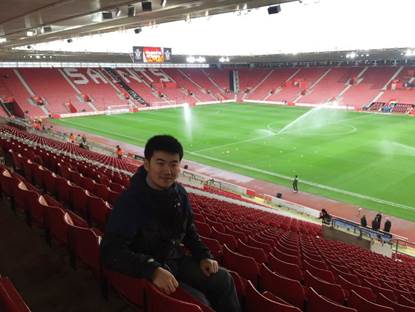
Name: Wang Haiquan
Gender: Male
Professional Title: Professor
Position: Vice Dean, Zhongyuan–Petersburg Aviation College
Academic Affiliations: IEEE Member; Henan Young Backbone Teacher; Member of the Intelligent Reasoning and Decision-Making Committee of the Chinese Association of Automation; Member of the Henan Provincial Advisory Committee for Aeronautical Programs.
Degree: Ph.D.
Education and Research Work Experience:
September 2019–February 2020: Visiting Scholar, University of British Columbia, Canada.
November 2015–October 2016: Visiting Scholar, Bournemouth University, UK.
May 2006–December 2009: Ph.D. in Aerospace Propulsion Theory and Engineering, Northwestern Polytechnical University.
September 2003–April 2006: Master's degree in Aerospace Propulsion Theory and Engineering, Northwestern Polytechnical University.
September 1999–July 2003: Bachelor's degree in Computer Science and Technology, Northwestern Polytechnical University.
Research Directions:
Data mining and artificial intelligence algorithms, and their applications to personal health management and machinery health management.
Academic Research Projects:
1. Ministry of Science and Technology High-End Foreign Experts Introduction Program: Key Technologies for China–Europe Intercontinental Green Logistics Based on Swarm Intelligence Optimization (G2021026006L), January 2021–December 2022.
2. Henan Higher Education Key Research Project: Intelligent Information Fusion Methods for Fault Prediction of High-End Aerospace Equipment (22A413011), January 2022–December 2023.
3. Henan Science and Technology Plan Project: Research and Development of a Human–Computer Interactive System for Intelligent Diagnosis and Decision-Making for Infectious Diseases (212102310547), January 2021–December 2022.
4. Henan University Young Backbone Teacher Training Project: Prediction and Evaluation of Pilot Health Status Based on Multi-Source Information Fusion (2020GGJS137), October 2020–September 2023.
5. Henan Science and Technology Plan Project: Research and Development of a Human–Computer Interactive System for Intelligent Diagnosis and Decision-Making for Infectious Diseases (212102310547), January 2021–December 2022.
6. Textile Industry Federation Scientific and Technological Guidance Project: Intelligent Scheduling Strategies for Textile Fabric Warehousing Systems (2020114), July 2020–July 2021.
7. Henan Higher Education Key Research Project: Airport Containerized Cargo Scheduling Strategies Based on a Parallel Dynamic Multi-Objective Bee Colony Algorithm (18A120005), January 2018–December 2019.
8. Henan Science and Technology Plan Project: Home Health Monitoring of Older Adults Based on a Dynamic Multi-Objective Bee Colony Algorithm (172102210588), January 2017–December 2018.
9. Zhengzhou International Science and Technology Cooperation Project: Cooperative Exploration by Multiple Rescue Robots (20150526), January 2016–December 2017.
10. National Natural Science Foundation: Control for Maintaining Safe Production Function Based on Decentralized Cooperative Communication (61304115), January 2014–December 2016.
Awards:
1. First Prize of the 2021 National Commercial Science and Technology Progress Award: Home Health Monitoring Technology for Older Adults Based on a Multi-Objective Bee Colony Algorithm.
2. Outstanding Paper Award, ICAMechs 2018 International Conference: “Research on Parallel Optimization of Artificial Bee Colony Algorithm,” 2018.
3. He has also repeatedly received first, second and third prizes for scientific and technological achievements from the Henan Provincial Department of Science and Technology and the Provincial Department of Education as a principal participant.
Representative Papers:
1.Haiquan Wang, Hans-Dietrich Haasis, Menghao Su, Jianhua Wei, Xiaobin Xu, Improved artificial bee colony algorithm for air freight station scheduling, Mathematical Biosciences and Engineering, 2022,19(12):13007-13027.
2.Haiquan Wang, Wenxuan Yue, Shengjun Wen, Xiaobin Xu, An improved bearing fault detection strategy based on artificial bee colony algorithm, CAAI Transactions on Intelligence Technology, 2022,7(4):570-581.
3. Wang Haiquan et al., A Data Classification Method Based on a Multi-Objective Bee Colony Algorithm, Journal of Chongqing University, January 2020.
4.Improved Artifical Bee Colony algorithm and its application in Classification, Journal of Robotics and Mechatronics, Vol.30, No.6, pp.921-926, 2018.
5. Wang Haiquan et al., Robot Path Planning Based on an Improved Artificial Bee Colony Algorithm, Control Engineering, 2016,23(9):1407-1411.
6.Haiquan Wang et al., Design and Optimization of Fractional Order PID Controller for Servo Motor, ICIC Express Letters, Part B: Applications, 2015,6(8):2213-2219.
7.Haiquan Wang et al., Double Inverted Pendulum Controller Optimization with Improved Artificial Bee Colony Algorithm, ICIC Express Letters, 2015,9(4):1127-1133.
Representative Works and Achievements:
1. Wang Haiquan, Principles and Applications of Bee Colony Algorithms, China Textile Press, March 2021.
2. Wu Fuzhuan, Dan Yongping, Wang Haiquan, TMS320F28335 Principles and Applications in Electrical Engineering, 13th Five-Year Plan Higher Education Textbook, Publishing House of Electronics Industry, January 2020.
3. Invention Patent: A Human Activity Detection Method Based on a Bee Colony Algorithm, June 2020 (ZL201810763627.0).
4. Invention Patent: Child Sleep Detection System and Monitoring Method Based on LightGBM and a Bee Colony Algorithm, October 2020 (ZL201910651762.0).
5. Invention Patent: TCN-Based Climate Trend Prediction Method for the Flood Season, September 2021 (ZL202010737477.3).
6. Invention Patent: A Data-Driven Intelligent Plant Cultivation System and Method of Use, February 2022 (ZL2020110578070).
Contact:
Email: wanghq@zut.edu.cn